Beating BC Hydro Time-of-Day Rates: Summer Cooling Tips for Vancouver Renters

Whether you rent an apartment or own a home in Metro Vancouver, you have probably opened your BC Hydro bill after a hot spell and wondered how on earth it climbed that high. With hotter summers and new Time-of-Day pricing rolling out, it is getting trickier to stay cool without roasting your wallet, too.
This guide breaks down how BC Hydro’s Time-of-Day rates work in summer 2026 and offers practical, budget-friendly ways to keep both your home and your bill as chill as possible—whether you’re a renter working around landlord restrictions or a homeowner looking to optimize your cooling.
Quick Primer: BC Hydro Time-of-Day Pricing (Summer 2026) for Anyone Paying Their Own Bill
Time-of-Day (TOD) pricing means the cost of electricity changes depending on the time of day. For most residential customers in BC in summer 2026, the pattern looks roughly like this:
- On-peak (most expensive): 4 pm – 9 pm
- Off-peak (cheapest): late evening, overnight, and early morning
- Mid-peak (in-between): the daytime hours between the cheap overnight and the expensive 4 pm – 9 pm window
- Summer Time-of-Day Rates (BC Hydro):
- 🟢 Off-Peak: 9 PM – 7 AM
- 🔴 On-Peak: 4 PM – 9 PM
- 🟡 Mid-Peak: 7 AM – 4 PM
Exact prices can change, so always double-check BC Hydro’s website or your bill for current rates. But the main idea is simple: avoid heavy electricity use from 4 pm to 9 pm whenever you can.
Timing Your Power Use in an Apartment
Households with detached homes can run dishwashers and laundry at midnight without bothering anyone. In an apartment or condo with shared walls and floors, late-night machines can get you noise complaints from your neighbours or landlord.
Instead of pushing everything to the middle of the night, aim for this practical schedule:
- Laundry: Morning or early afternoon is your sweet spot. Any time before 4 pm is usually a safe zone for both noise and lower pricing. Avoid starting a wash after about 3 pm so the dryer can finish before on-peak kicks in.
- Dishwasher: If you have one, run it after 9 pm only if it is quiet enough for your building. Otherwise, run it right after breakfast or lunch.
- Big plug-in appliances (portable AC units, space heaters in shoulder seasons, etc.): Try to pre-cool or pre-heat earlier in the day so you are not cranking things during 4 pm – 9 pm.
Think of on-peak time as “lights and laptops only” whenever possible.
Cooling Solutions Specifically for Renters
If you rent, you have unique cooling challenges: you cannot install a permanent air conditioning system, you cannot upgrade windows, and you need to avoid doing anything that might irritate a landlord. Here are cooling and energy-saving strategies that work within a rental situation.
Portable AC Units and Fans: The Renter’s Toolkit
A portable AC unit and a few fans are your best friends as a renter:
- Portable AC: No installation needed, and it moves with you if you change apartments. Place it in the room you use most, and close doors to unused spaces. A modest unit (roughly 8,000–12,000 BTU) is enough for a bedroom or living area and uses less energy than a massive system.
- Window fans: These are cheap and require no setup beyond fitting them into a window frame. They work best early morning and late evening when outside air is cooler than inside.
- Ceiling fans (if you have them): Use these on low speed during hot afternoons to move air around without adding much heat or noise.
Blackout Curtains and Light-Blocking Solutions
Blackout curtains or thermal curtains are one of the easiest renter upgrades you can make:
- Install them on south- and west-facing windows where afternoon and evening sun is strongest. Close them by late morning on hot days.
- They’re removable: You can take them with you when you move, and your landlord will not be upset about window coverings.
- Budget option: If blackout curtains are too pricey, even a light-coloured sheet, white sheet, or light-blocking blind will help cut the heat.
Avoid Heat-Generating Appliances During Peak Hours
As a renter, you cannot change your stove or cooking setup, but you can be smart about when and how you use heat-producing appliances:
- Skip the oven in summer: Use a microwave, toaster oven, air fryer, or no-cook meals (salads, sandwiches, pre-made items) during July and August. If you must use the oven, do it before 4 pm and then open windows later when it cools down.
- Run laundry in the morning: Dryers generate heat. Get your laundry done before 4 pm so the heat does not add to your cooling burden during on-peak pricing hours.
- Avoid running dishwashers during 4–9 pm if you have one, both to save on electricity and because the heat and steam will make your AC work harder.
Talk to Your Landlord About Energy Upgrades
If your apartment is particularly hot or your hydro bills are consistently high, it is worth having a conversation with your landlord or building manager:
- Ask about building-wide improvements: If many tenants are struggling with heat, the landlord might consider upgrading windows, adding shade on south-facing walls, or improving ventilation. These things benefit the whole building and can increase property value.
- Propose low-cost upgrades: Things like weather stripping, caulking air leaks, or installing temporary reflective film on windows are inexpensive and often allowable.
- Keep records: If you’re paying your own hydro, save your bills. If bills spike during heat waves, it shows the problem is structural, not just your usage—useful if you ever need to dispute a charge or apply for an energy credit.
Smart Cooling Strategies for Renters and Homeowners
Most Vancouver homes—whether rented or owned—were not built with extreme heat in mind. Renters often face constraints (no major renovations allowed, limited cooling options), while homeowners might have more flexibility. Here are practical cooling strategies that work for both situations.
1. Pair Your AC with a Ceiling Fan (and Turn the Thermostat Up)
If your suite has a ceiling fan, it is one of the cheapest cooling tools you own.
A fan does not actually lower the air temperature, but it makes your skin feel cooler by moving air across it. That means you can:
- Set your AC a few degrees higher (for example, 26–27°C instead of 22–23°C)
- Use the fan to create a breeze where you are actually sitting or sleeping
This combo can noticeably cut how long your AC needs to run while still feeling comfortable.
Just remember to turn the fan off when you leave the room. It cools people, not air.
2. Block South and West Sun “By Noon or Forget It”
Direct sunshine through glass is like a space heater you did not ask for. In Vancouver, afternoon and evening sun on south- and west-facing windows can turn a small apartment into a sauna.
The rule of thumb: close blinds or curtains on south- and west-facing windows by late morning (around 11 am or noon) on hot days. Once the heat has poured in and the walls and floors warm up, your AC and fans have to work much harder.
- If you have blackout curtains, use them on the sunniest windows.
- No blackout curtains? Even basic blinds or a light-coloured sheet across the window will help.
- Keep the window closed during the hottest hours if outside air is hotter than inside.
You can always open up in the late evening once the outside temperature drops.
3. The Wet Towel Trick (For When You Do Not Have AC)
If you are relying only on fans, a simple trick can buy you a bit more comfort during heat waves:
- Soak a hand towel or small bath towel in cool water.
- Wring it out well so it is damp but not dripping.
- Place it over your shoulders, on your lap, or across your forehead and neck while you sit near a fan.
As the water evaporates, it helps cool your skin. You can also:
- Run your wrists or feet under cool water for a minute.
- Keep a spray bottle of water in the fridge and mist your face and neck when you sit by the fan.
These tricks use almost no electricity but can make a muggy evening more bearable, especially in top-floor suites without AC.
4. Avoid the Oven: Use the Microwave or Air Fryer
A full-size oven does two things on a hot day:
- Uses a lot of electricity
- Dumps a pile of heat into a space you are already struggling to cool
Whenever you can in July and August:
- Swap the oven for a microwave or air fryer.
- Make more no-cook meals (salads, sandwiches, pre-cooked rotisserie chicken, etc.).
- If you absolutely must bake, try to do it early in the day before 4 pm and then keep windows open later when it is cooler outside.
Less heat from cooking means less work (and cost) for your AC or fans.
Small Habits, Real Savings
You do not have to overhaul your life to shave a bit off your summer hydro bill. A few small tweaks, especially in a compact apartment, can add up.
1. Use Power Bars to Tame “Vampire” Devices
Electronics like TVs, game consoles, streaming boxes, chargers, and speakers often draw a little power even when they are “off.” This is sometimes called phantom or vampire power.
Instead of unplugging everything individually, plug clusters of electronics into a power bar with a switch:
- Living room: TV, soundbar, game console, streaming box on one switched bar.
- Desk: monitor, speakers, printer on another bar.
Before bed or when you leave for work, flip the switch on the bar. It is a one-second habit that stops a slow drip of electricity all day long.
2. Set Your Fridge and Freezer to the Right Temperatures
Colder is not always better. Your fridge and freezer use more electricity than almost any other appliance because they run 24/7.
BC Hydro and food safety guidelines generally recommend:
- Fridge: about 3°C
- Freezer: about −18°C
If your settings are much colder than that, you are paying extra for no real benefit. Use a simple fridge thermometer for a few dollars to double-check.
3. Shorten Showers (Helps Even If You Have Shared Hot Water)
Shorter showers save hot water and the electricity or gas used to heat it. Even if your building has shared hot water that you do not pay for directly, you may still benefit because:
- Some buildings recover those costs in your rent or fees.
- Less steam in a small bathroom means less moisture to cool and dehumidify in summer.
Even cutting two or three minutes from your usual shower adds up over weeks and months.
Do You Pay for Your Own Hydro? Check Your Building’s Metering
Before you stress too much about your own habits, it is worth understanding how your building is metered. In BC rentals, you will usually see one of two setups:
- Suite metering: Your unit has its own meter, and BC Hydro bills you directly. In this case, Time-of-Day rates and all the tips above matter a lot to your personal bill.
- Shared or bulk metering: The building has one big meter, and the landlord or strata pays BC Hydro. The cost is then baked into your rent or fees, often as a flat rate.
If you are not sure which you have, look for:
- Your lease: Does it say you are responsible for BC Hydro?
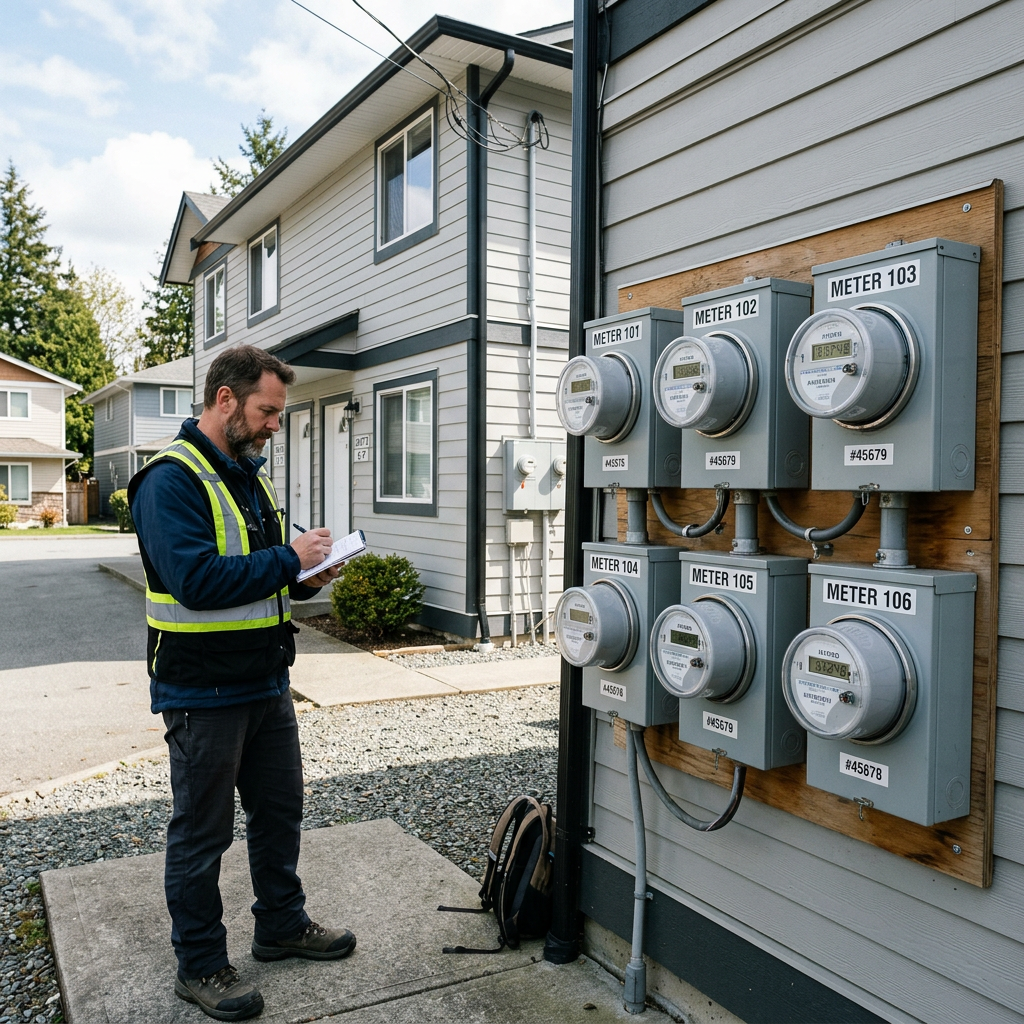
- Your mailbox or hallway: Older buildings sometimes have a row of meters labelled by suite number.
- Your bank statement: Are you paying BC Hydro directly every month, or is it just rolled into rent?
Even in a shared-meter building, it is still worth being mindful of use. High building-wide energy costs can show up later as rent increases or reduced maintenance.
Putting It All Together
Summer in Vancouver is getting hotter, and electricity is not getting cheaper. But you are not powerless. If you:
- Avoid heavy electricity use between 4 pm and 9 pm,
- Use fans smartly and block sun before it bakes your suite,
- Skip the oven and trim small energy leaks like vampire power and too-cold fridges,
- Understand whether you are on your own meter or a shared one,
—you can stay a lot more comfortable this summer without dreading your BC Hydro bill. And if next month’s statement still looks off, you will at least have a clearer sense of where to start troubleshooting.
#BCHydro #SaveElectricity #HydroTips #ApartmentLiving #BCSummer #EnergySaving #HydroBC #SummerTips #SaveMoney #CanadianLiving #ElectricityBill #TimeOfDay #GreenLiving #MoneyTips #VancouverLiving