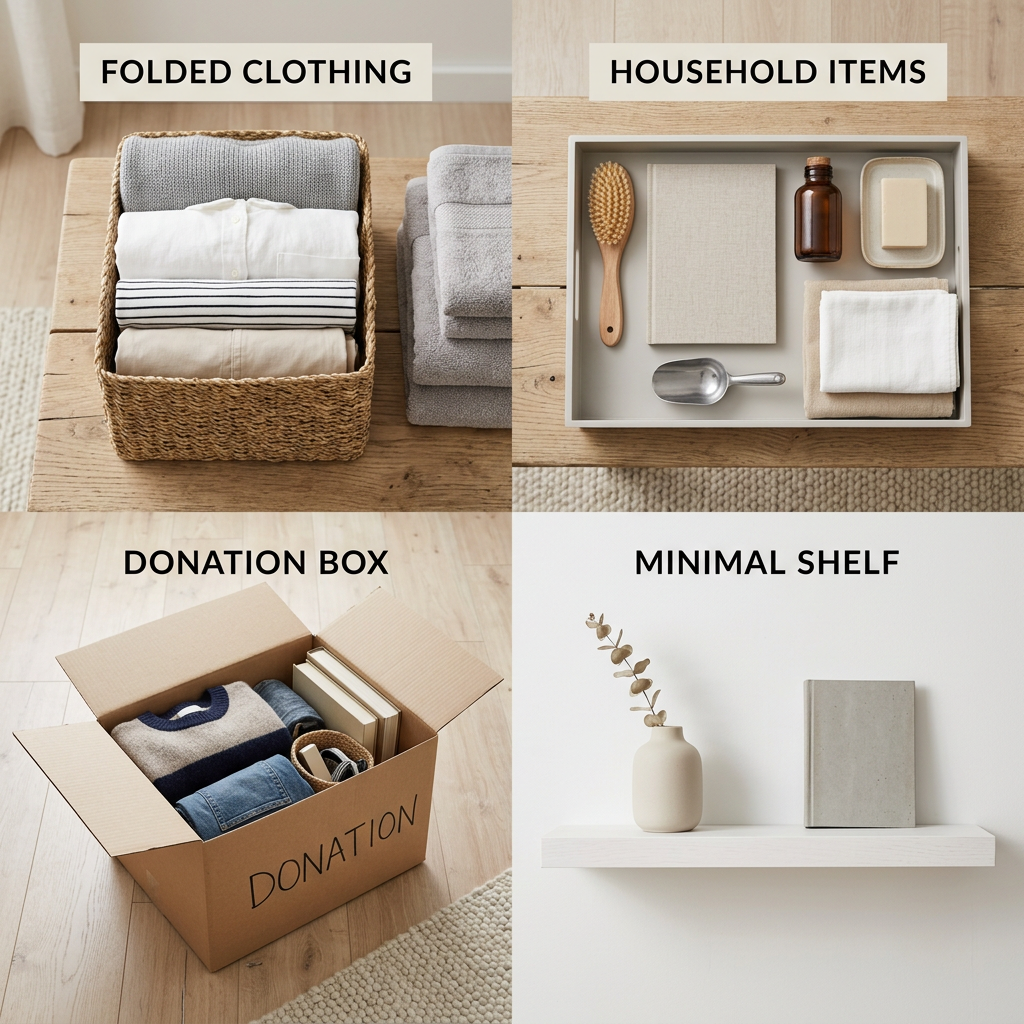
I’ve decluttered my kitchen to 12 tools, my closet to one rack, and my shelves to books I’ve actually read — using four different methods. Not all at once, and not all successfully the first time.
Here’s the honest ranking: KonMari, the 90-day box method, Swedish death cleaning, and one-in-one-out — scored on what actually works, who each suits, and the traps I fell into. If you’ve ever stalled out by noon, the method was probably wrong for you, not the other way around.
#4: Swedish Death Cleaning — powerful idea, wrong framing for most people
The concept: imagine you’re gone, and someone you love has to sort through everything you own. Would you want them to deal with this? Keep what passes the test; let go of the rest. It comes from the Swedish döstädning, and Margareta Magnusson’s little book on it is genuinely moving.
It’s last not because it’s bad, but because the framing misfires for most people under 50. At 30-something, the “someone will sort this after I die” lens made every decision heavy and strange — keeping a chipped mug shouldn’t feel like writing a will. The mortality framing that’s profound at 70 is paralyzing at 35.
Who it’s for: older adults doing a genuine life-stage clearout, anyone handling a parent’s estate (the kindest framework I know for that job), and people drowning in paperwork and “someone might need this” archives. “Would anyone want to inherit sorting this?” is devastatingly effective on filing cabinets.
The trap: starting here. It’s an endgame philosophy, not a starter system — start here and you’ll feel morbid or quit by lunch.
#3: KonMari — brilliant for clothes, exhausting for everything else
“Does it spark joy?” I did the full process on my clothes two years ago: every garment piled on the bed, picked up one by one, kept only what sparked joy. It worked beautifully — closet dread became one rack of things I wear. The joy criterion is perfect for clothes, because clothes are about how they make you feel.
Then I tried to KonMari the kitchen. And the junk drawer. That’s where it fell apart.
The problem is decision fatigue. Interrogating your feelings about 200 kitchen objects is cognitively brutal. By item 60, everything sparks joy (you’re tired, you want to keep it) or nothing (you’re tired, you want it gone) — neither answer trustworthy. I spent a Saturday on one room and finished with a headache and a suspicion I’d kept the wrong things.
Second problem: joy is the wrong question for utilitarian objects. Does my plunger spark joy? No. Do I need it? Yes. By the time you’re rationalizing the plunger, the method has stopped deciding for you — which was the whole point.
Who it’s for: anyone doing a first big clothes clearout — genuinely the best wardrobe method. Also good for sentimental items and books, where feeling is the criterion. Just don’t run your whole house through it.
The trap: the all-at-once piling. “Gather every book you own” sounds inspiring and feels like burial. Do clothes only, declare victory, use another method for utilitarian zones.
#2: One-in-one-out — the best maintenance system, but not a decluttering method
The rule: nothing new enters unless something old leaves. Buy a shirt, donate a shirt. Two years on, it’s why my kitchen is still 12 tools and my closet one rack.
The honest limitation: one-in-one-out doesn’t declutter. It maintains — a governor on future accumulation, not a tool for the backlog. Overflowing drawers stay overflowing; it just freezes them in place. Purge with another method first, then let this one keep you from ever purging again.
That’s not small: most people re-accumulate after a big purge and redo it in three years. One-in-one-out is the only method here that addresses re-accumulation — the most valuable long-term, even though it can’t do the initial job.
Who it’s for: everyone, after the purge. It’s the epilogue, not the story.
The trap: using it as the purge. The backlog doesn’t decay on its own — you have to actively remove it once.
#1: The 90-day box method — the one that actually cleared my kitchen
This is the method behind my 12-tool kitchen, and the one I’d hand anyone starting from an overflowing house:
Step one: everything out. Every drawer, cabinet, and counter — onto the table. It looks insane. That’s the point: you need to see the full absurdity before your brain will let go of any of it.
Step two: put back only what you’ve used in the last month. Not “might use” — used. Four minutes, 10 of the final 12 tools. The recency test is ruthless and fast: a factual question with a factual answer, no feelings to interrogate.
Step three: everything else goes in a box. Seal it, date it, closet it. Reach into the box within 90 days and the item earns its way back. After 90 days, the sealed box goes to donation — unopened.
I opened mine twice: the sheet pan, the colander. Everything else — garlic press, avocado slicer, banana hanger, rice cooker — left without me ever missing them.
Why it wins: it removes the fear, the actual obstacle. Nobody fears fewer gadgets; they fear needing something they threw away. You’re not throwing things away — just putting them in a box. The 90 days decide for you, and by donation day the letting-go happened three months ago. Decluttering with a safety net, and the safety net is what gets people to actually do it.
It also sidesteps decision fatigue. Step two is the only decision point, and it’s factual, not emotional. The box absorbs everything you’re unsure about — about 70% of the stuff, in my experience. KonMari makes you decide 100% of your possessions in a weekend; the box method decides 30% and lets time handle the rest.
Who it’s for: anyone facing the initial purge — overflowing drawers, packed closets, garages of “maybes.” Especially good for the “but what if I need it” people, because the box is the answer. You probably won’t need it. But it’s in the closet if you do.
The trap: the box becomes storage. The 90-day deadline must be real — put the donation date in your calendar when you seal the box. On the day, it leaves sealed: no “one more look,” which restarts the attachment cycle. A friend has had a “90-day box” in their garage for four years. That’s not the method. That’s a box.
The verdict
The full sequence I’d prescribe:
- Purge with the box method — room by room, not all at once.
- Do clothes KonMari-style if the wardrobe is its own disaster.
- Install one-in-one-out the day the purge ends, so you never do this again.
- Borrow the Swedish death cleaning question for paperwork, files, and the storage locker — where it’s devastatingly effective.
Most decluttering advice fails by handing you one method for every category. But clothes aren’t plungers and the junk drawer isn’t a bookshelf. Match the method to the category, let time make the hard calls, and put a real date on the box.
Ninety days from now, you’ll donate a sealed box of things you never missed — and wonder why you ever thought you needed them.