How I Built a 33-Item Capsule Wardrobe and Cut My Clothing Costs in Half

Hey, Jay here. A few years ago, my closet looked like a Winners clearance rack after a long weekend. I was buying “deals,” chasing trends, and somehow still feeling like I had nothing to wear. The kicker? When I actually sat down and did the math, I realized I was quietly burning through $1,500–$2,000 a year on clothes in Canada… and still defaulting to the same five outfits.
This post is my playbook for flipping that script: building a minimalist capsule wardrobe, spending less, buying better, and clearing out the mental clutter that comes with an overflowing closet.
The Real Cost of Fast Fashion (Canadian Numbers)
Let’s talk about what many of us quietly spend without thinking. When I looked back at a full year of my bank statements, my clothing spending roughly broke down like this:
- One or two “big” mall trips: around $300 each (shirts, sneakers, maybe a jacket) – about $600/year.
- Random impulse buys (a $40 hoodie here, $25 tee there) – easily $50/month, or $600/year.
- Seasonal “refreshes” (new shorts, a couple of sweaters, maybe boots): roughly $300/year.
Total: around $1,500/year. Some years, with a winter coat or nicer shoes, it crept closer to $2,000.
And this isn’t wild, luxury-level spending. This is pretty normal Canadian fast-fashion behaviour: sale racks at the mall, quick online orders, cheap basics from big-box stores.
The problem isn’t just the money. It’s the waste:
- Cheap fabrics that pill after 10 washes.
- Jeans that lose their shape in a season.
- Shirts that twist, fade, or shrink after a few trips through a Canadian winter dryer cycle.
On paper, fast fashion looks “affordable.” In real life, you end up re-buying the same things every year. That’s not frugal; that’s just a subscription to low-quality clothing.
The 33-Item Capsule Wardrobe Concept (Project 333, Jay-ified)
The idea that changed everything for me is based on Courtney Carver’s Project 333: you dress with 33 items or fewer for 3 months. I adapted the concept to fit my life in Canada (where we get all four seasons and then some).
Here’s how my 33-item capsule works for a given season (spring/summer or fall/winter):
- 8–10 tops (tees, shirts, sweaters)
- 4–5 bottoms (jeans, chinos, shorts or heavier pants depending on the season)
- 3–4 layers (cardigans, overshirts, hoodies, light jackets)
- 2–3 jackets or coats (denim, parka, rain shell, depending on the season)
- 3–4 pairs of shoes (sneakers, boots, dress shoes, sandals)
- A few wildcards (a dressy outfit, a favourite graphic tee, or a special piece)
Workout gear, pyjamas, underwear, socks, and true “outerwear emergency” items (like a ski jacket you use twice a year) can live in their own category if you want. The point is to ruthlessly simplify what you reach for daily.
When I built my first 33-item capsule, I made one rule: everything had to work with everything. That meant a calm colour palette (navy, grey, black, white, denim) with maybe one or two accent colours. Suddenly, getting dressed became a 30-second operation.
Buying Less but Better: What I Actually Spend Now
Once I committed to a capsule wardrobe, my spending completely shifted. Instead of spreading about $1,500 a year on random purchases, I started thinking strategically: buy quality pieces when they go on sale or at outlet stores, where you can find great deals year-round.
Pause before buying anything impulsively just because it looks good on a mannequin or the colors are appealing — you may not actually wear it. This is especially true for shoes: once you start using insole cushions, they can feel too large, and over time changes in your foot shape may make them uncomfortable to wear.
- High-quality basics (tees, shirts, jeans) that last 3–5 years.
- Sturdy outerwear that survives real Canadian winters.
- Shoes with replaceable insoles and repairable soles.
Here’s what my typical annual clothing budget looks like now:
- 2–3 quality tees at $35 each: ~$100
- 1 good pair of jeans every 2 years at $140: ~$70/year
- 1–2 shirts (button-ups or flannels) at $70 each: ~$140
- 1 pair of versatile shoes/boots every 2 years at $200: ~$100/year
- Outerwear upgrade (a solid jacket or coat) every 3–4 years at $300: ~$75/year
Total: around $485/year, let’s round up to $500 to be safe.
Compared to my old $1,500/year habit, that’s a savings of about $1,000 every year. Over 5 years, that’s $5,000. Invested at a modest 5% annual return, you’re looking at roughly $5,800–$6,000. That’s a used car, a serious travel fund, or a big chunk off your line of credit.
And I’m not even including the environmental cost: fewer items produced, shipped, and eventually tossed into Canadian landfills.
Shopping Secondhand Without Feeling Scruffy
Secondhand is where capsule wardrobes go from “nice idea” to “obvious money hack.” In most Canadian cities, you can do extremely well with a mix of:
- Curated consignment stores (often in trendy neighbourhoods)
- Thrift stores (Value Village, Salvation Army, local shops)
- Online marketplaces (Facebook Marketplace, Poshmark, Depop)
Some real numbers from my own closet:
- Wool coat: retail around $350, bought secondhand for $80.
- High-quality jeans: retail $150, picked up barely worn for $40.
- Button-up shirt from a Canadian brand: retail $90, thrifted for $14.
I aim for this rule: try to buy 45% of my clothing secondhand, especially for items where fit is forgiving (outerwear, sweaters, shirts).
If I can cut the price of an item in half by going secondhand, and that item lasts 3–5 years, the long-term savings stack fast. That $350 coat I bought for $80? Even if I only wear it for 4 winters, that’s $20 per winter versus about $90 per winter at full retail.
How I Care for My Clothes So They Actually Last
Buying better is only half the game. The other half is not destroying your clothes in the laundry. Here’s my simple, Canadian-winter-tested care routine:
- Wash less often. Jeans and sweaters don’t need a wash after every wear. I’ll go 5–7 wears unless something is obviously dirty.
- Cold water, gentle cycle. It’s easier on fabrics and saves on your hydro bill.
- Hang dry when possible. The dryer is brutal on elastic and fibres. I use a simple drying rack in my apartment.
- Spot clean instead of full washes. A small stain doesn’t mean the whole garment needs a full cycle.
- Rotate your shoes. Letting boots and sneakers fully dry between wears extends their life.
- Do tiny repairs early. I’m not a tailor, but I can sew a button and fix a small seam. Ten minutes now saves a replacement later.
All in, this routine probably adds 1–2 extra years of life to most of my clothes. If a $140 pair of jeans lasts 4 years instead of 2, that’s the difference between $70/year and $35/year for that item.
The Mental Clarity of Fewer Choices
Money aside, the biggest win from my capsule wardrobe is mental. My mornings used to start with: “What do I wear?” followed by 10 minutes of trying on stuff, feeling slightly annoyed, and leaving a pile on a chair.
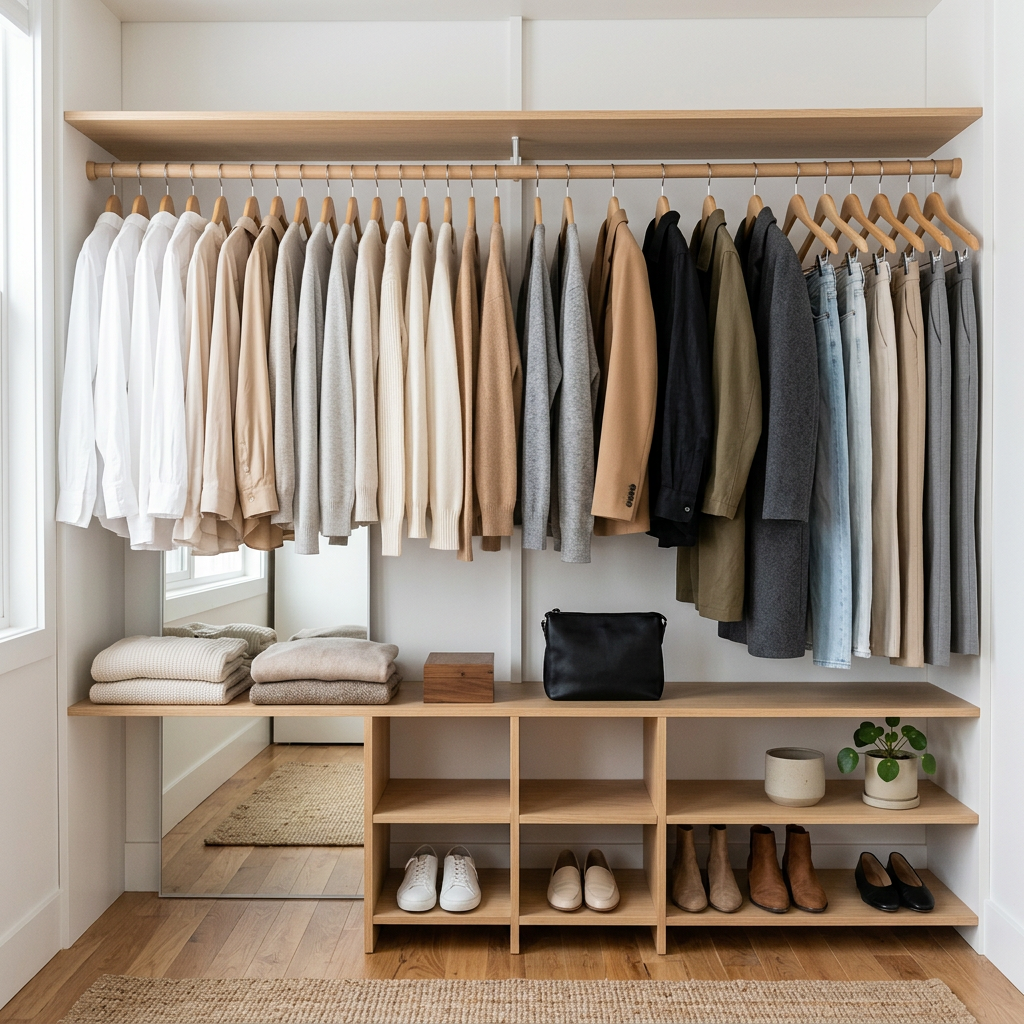
Now my closet is mostly empty space with a tight row of things I actually love and wear. I know that:
- Everything fits.
- Everything works with everything.
- There are no “maybe someday” or “if I lose 10 pounds” items silently judging me.
Decision fatigue is real. Every choice you make in the morning drains a little bit of focus. A capsule wardrobe narrows that window. When you only own things you like and everything works together, getting dressed becomes a background task, not a daily project.
My brain feels quieter. I don’t scroll clothing ads the same way. I don’t wander into the mall “just to look around.” That freed-up attention goes into work, relationships, or just enjoying a slow coffee.
Your Turn: Count Your Closet
If you want to try this, don’t start by shopping. Start by counting.
Here’s your challenge from Jay’s Playbook: Sometime this week, I want you to go to your closet and actually count how many clothing items you own. Not socks and underwear, but everything else: tops, bottoms, dresses, jackets, shoes.
- Write the number down.
- Then ask yourself: if I could only keep 33 items for the next 3 months, what would make the cut?
That list of “keepers” is the beginning of your capsule wardrobe—and possibly the beginning of saving $1,000 a year without feeling deprived. If you try it, let me know how many items you counted and what surprised you most.